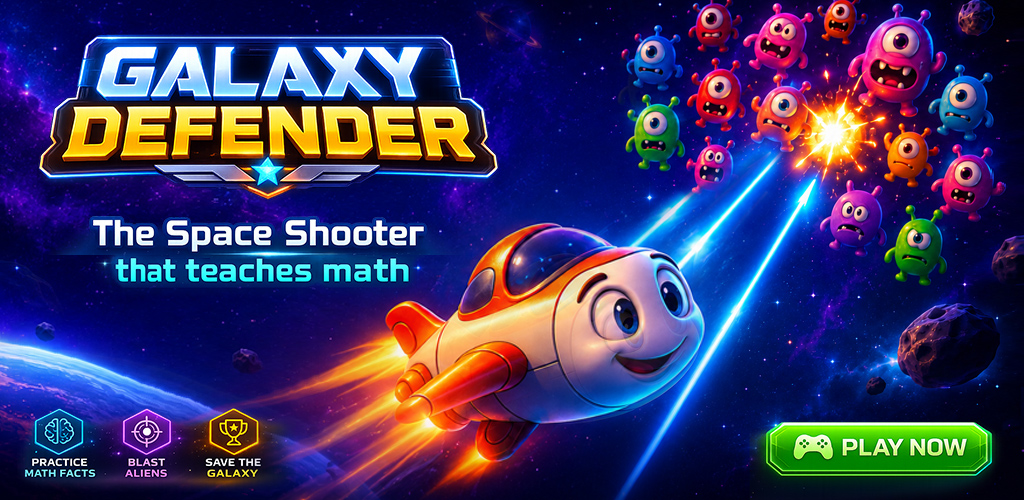
The space shooter that teaches math facts.
Your child thinks they're saving the galaxy. They're actually drilling addition, subtraction and times tables — with questions that adapt to their level, read aloud by a friendly voice, and rewards that only unlock by getting the math right.
Most math apps put the game after the worksheet. Galaxy Defender puts the math inside the game: the battle freezes mid-wave, one giant question fills the screen, a warm voice reads it out loud — and answering right is how you earn stars, ships and new planets. Kids do 20–40 problems in a five-minute mission without ever calling it practice.
Brain Boosts start on wave 1 and re-arm every 15–25 seconds, so a mission is packed with practice instead of one token question at the end.
A persistent skill level tracks your child, not the wave number. Rolling accuracy nudges the difficulty up when they're flying and quietly eases it back when they're stuck — so it never turns into a wall.
Numbers, operators and encouragement are all real recorded voice — pre-readers can play on their own, and hearing “seven plus five” builds the number language that reading a worksheet doesn't.
Kids get three shots at the right answer. Miss all three and the announcer just tells them the answer and cheers them on. Mistakes cost nothing but a moment — so kids keep guessing instead of freezing.
Between waves, kids trace a giant glowing digit with a finger — a handwriting/number-formation drill hiding inside the reward screen, with combo bonuses for a clean trace.
Facts aren't tracked as one blurry score. Every question your child answers is filed into a fact family — and each family is a planet that stays dark until they've truly got it. Mastering a planet is worth +1,500 ⭐ and unlocks a Cosmic ship.
Times tables are opt-in: pick “Add & Take Away” for younger pilots, or switch on “Times Tables Too” for big kids. Multiplication questions ramp on your child's own × experience — turning it on never floods a beginner with 8 × 7.
Tap the ⚙️ gear, answer a quick grown-up gate question (like 7 × 8), and the Parent Zone opens — no login, no account, nothing to sign up for.
Accuracy bars for every operation your child has practised, so you can see at a glance that subtraction needs work while addition is solid.
Privacy: by default everything stays on your own device — no account, no sign-in, no tracking, no ads and nothing to buy. If you want progress saved across devices, you can create a free parent account from this screen; then we store your email, your child's first name and age band, and their play and math results. We never ask for a photo of your child, and one tap deletes the lot. Privacy Policy · COPPA Notice · Terms
Example screen. Real numbers come from your child's own play and never leave the device.
Voiced comic-book cinematics, a world map that unlocks planet by planet, and named boss monsters with their own portraits and taunts. Beat GLOOMZILLA, free the Bloop aliens — then the map opens up.
The cutest aliens in the galaxy are trapped in bubbles by grumpy GLOOMZILLA.
PlayableThe soggy sea-beast TIDEZILLA froze the glowing oceans solid.
PlayableA blazing world of fire aliens — new story panels and a new nemesis in the works.
Coming soonThe final throne of the galaxy. Only the sharpest math pilots get there.
Coming soon18 collectable ships across three rarities — and the best ones aren't for grinding, they're for knowing your facts. Cosmic ships unlock by mastering a Math Galaxy planet; Legendaries need the whole galaxy lit up.
Six Classic hulls earned with career stars (Banana Boomer, Donut Dasher, Ducky Rocket…), six Cosmic ships each unlocked by mastering a math planet, and six Legendary ships for galaxy-wide mastery.
Cosmic ships fire 15% faster; Legendary ships fire 25% faster and get a permanent 3-shot spread. Real, felt rewards for real learning — not just a new paint job.
1-minute Quick Patrol, 3-minute Mission or 5-minute Deep Space — a hard timer parents can count on. Every mission ends in stars and a celebration, never a fail screen. Big kids unlock the Endless Challenge.
A fresh daily goal — “Answer 3 Brain Boosts!”, “Master a planet!”, “Zap 30 aliens!” — shown before lift-off, worth a big career-star bonus. The reason to come back tomorrow.
Cadet (nice & easy), Ace (fast!) or Legend (super fast!!) — the arcade difficulty is separate from the math difficulty, so a 5-year-old can play slow and still get real questions.
Crowned mega-aliens with their own health bar and a telegraphed dive attack. Blast one down and the screen erupts in confetti.
Triple Blaster, Super Speed Pew-Pew, Shield Bubble, Rainbow Mega Laser and the screen-clearing STAR BOMB.
Hundreds of recorded lines — the questions, the countdown, each ship's name, the story, the timer warnings. Kids who can't read yet never get stuck.
Starlight Bounce, Cosmic Candy, Rocket Parade, Bubble Nebula and a stomping boss theme — plus one-tap mute for quiet time.
Slide to fly — the ship shoots by itself. Nothing to learn, so all the effort goes into the math, not the controls.
Install it to the home screen and it plays with no connection — car rides, waiting rooms, aeroplanes. Progress saves on the device.
No ads, no purchases, no accounts, no chat, nothing scary. Even Game Over cheers them on to try again.
No tutorial, no menus to puzzle over — little defenders are answering questions within seconds.
Cadet, Ace or Legend — then “Add & Take Away” or “Times Tables Too”.
Drag a finger (or use arrow keys). Your ship fires all by itself.
The battle freezes, the question is read out loud — fly into the right answer.
Master a fact family, bank +1,500 ⭐ and unlock a brand-new Cosmic ship.
Roughly ages 4–9 (pre-K through grade 3). Younger children play with addition and subtraction only, everything read aloud so reading isn't required. Older children switch on times tables and the Endless Challenge. The difficulty follows the child, so siblings of different ages can share one device.
Addition and subtraction facts within 20 — grouped as Add to 5, Add to 10, Doubles, Big Adds, Take to 10 and Take to 20 — plus the ×2, ×5 and ×10 times tables as an opt-in mode. That maps closely to typical K–3 fact-fluency goals.
No. No ads, no purchases, no subscriptions, no chat, and no third-party tracking. The whole game is free. An account is optional and also free.
By default, nowhere — scores, answers and progress live in your own browser's local storage on your own device, and the game never contacts our server about them.
If you choose to create a free parent account (it's tucked behind the grown-up question in the Parent Zone, so a child can't do it), we then store your email address, your child's first name and age band, and their play and math results, so progress follows them between devices and you can see it. We never ask for a photo of your child, we never sell or share any of it, and the Parent Zone has a one-tap button that permanently deletes the account and everything in it. See the Privacy Policy and COPPA Notice.
No — tap Play and it runs in the browser on a phone, tablet, Chromebook or computer. You can also “Add to Home Screen” to install it as an app and play offline.
Yes — that's what the mission timer is for. Pick 1, 3 or 5 minutes before lift-off and the mission genuinely ends there with a celebration, not a “one more life” trap.
No download, no sign-up, no ads. Tap Play and your Starfighter is answering questions in ten seconds.
Parents: see your Starfighter's math accuracy, question-by-question — no login needed.